|


|
|
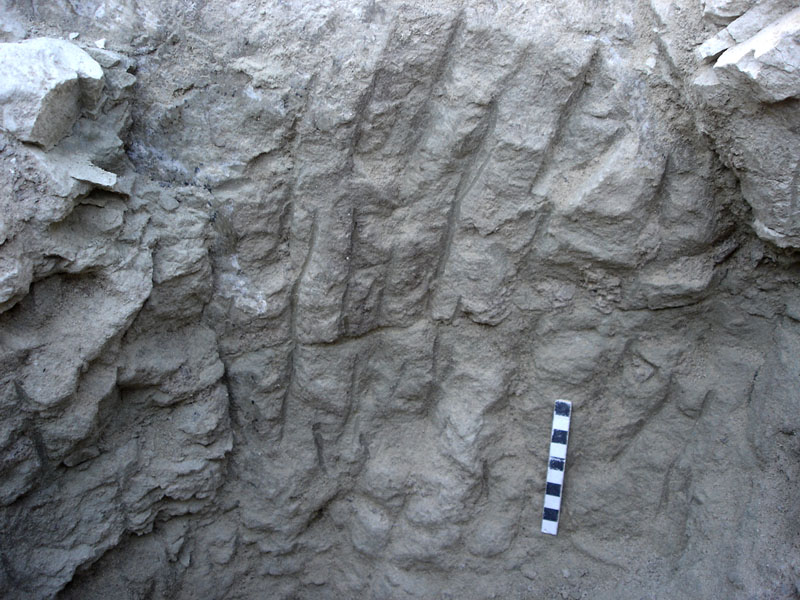
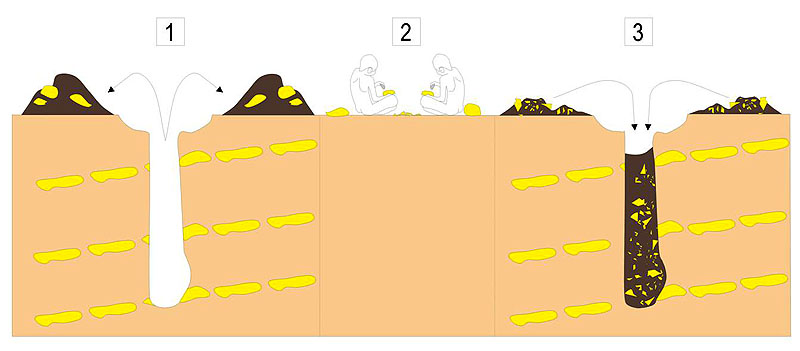
Work inside the shafts was tough and commonly uncomfortable. Extraction became more difficult with depth. The tool marks left on numerous shaft walls bear testimony to this, their length, inclination and shape changing as the shafts become deeper. Some shafts contain ledges, narrowings, niches, holes, footholds and perforated veins that given an idea of how the miners worked in these shafts. Flint picks were used dig the shafts. Quartzite boulders of different size, brought from the nearby river, were used to break flint blocks and veins. They also used flint wedges, and perhaps wooden wedges, to loosen large nodules which they removed to the surface. Here they were worked to produce blades. In one particular part of the site, flint veins were extensively mined along their lengths and depths. In fact, two levels of lateral excavation represented by very narrow galleries communicate some 11 shafts. This system of shafts and galleries was probably used to exploit very good veins of (perhaps easily knapped) flint to the greatest possible extent. Large flint nodules were also extracted from the walls of shafts, usually deep down, leaving behind irregular holes and niches. They were then brought to the surface probably making use of ladders and ropes. However, these tools, if they were used, have not survived the passage of time. Two small circular holes were found on opposite sides of the mouth of one shaft. These have been interpreted as attachment points for securing some form of winch or crossbar for hoisting materials out of the shaft. The shafts were filled with the same material removed from them, once the flint had been extracted from it. Knapping wastes were also disposed of in these spent shafts. This may have been the miners’ way of preventing accidents.
|
  A miner removing soil from a shaft
Illustration: Juan M. Álvarez Cebrián Image 1 of 17 |